
- 中国科学学与科技政策研究会
- 中国科学院科技战略咨询研究院
- 清华大学科学技术与社会研究中心
ISSN 1003-2053 CN 11-1805/G3
科学学研究 ›› 2026, Vol. 44 ›› Issue (6): 1229-1240.
曲冠楠1,2, 接园3, 王璐瑶4( ), 阮顺芳2
收稿日期:2025-04-16
修回日期:2025-06-04
出版日期:2026-06-15
发布日期:2026-06-15
通讯作者:
王璐瑶(1991-),女,副教授,博士, E-mail: 作者简介:曲冠楠(1986-),男,特别研究员,副教授,博士。基金资助:
QU Guan-nan1,2, JIE Yuan3, WANG Lu-yao4(), RUAN Shun-fang2
Received:2025-04-16
Revised:2025-06-04
Online:2026-06-15
Published:2026-06-15
摘要:
新时代,数字化创新能力(Digitalized Innovation Capabilities, DICs)作为赋能企业可持续竞争优势的核心,已成为创新管理研究与企业创新实践的重要关切。然而,尽管主流研究对数字创新的相关概念、内涵、边界与影响的探索已渐深入,但关于企业数字化创新能力(DICs)的清晰界定、严谨测度与可靠实证仍然缺乏,致使关于其前因与产出的系统分析面临挑战。基于文献采集,研究对数字化创新能力的理论基础进行系统回顾,将其定义为企业通过对数字技术的开发和利用来赋能自身创新过程的能力,涵盖数字开放性创新能力(O-DICs)、数字可供性创新能力(A-DICs)和数字自生长性创新能力(G-DICs)3个子维度。继而,基于访谈调研与问卷调查,运用探索性因素分析和验证性因素分析方法,实施企业数字化创新能力量表(DICs Scale)的开发与信效度检验,并进一步验证数字化创新能力的不同维度对企业创新绩效的影响。
中图分类号:
曲冠楠, 接园, 王璐瑶, 阮顺芳. 企业数字化创新能力:内涵、测度与影响[J]. 科学学研究, 2026, 44(6): 1229-1240.
QU Guan-nan, JIE Yuan, WANG Lu-yao, RUAN Shun-fang. Digitalized innovation capabilities: Concepts, measurement, and performance[J]. Studies in Science of Science, 2026, 44(6): 1229-1240.
| 研究维度 | 主要观点/内涵阐述 | 代表学者 |
|---|---|---|
| 概念定义 | 数字创新指将数字和物理组件进行新的组合以生产新产品 | Yoo等(2010) |
| 数字创新是指将数字能力整合至物理组件的过程 | Jahanmir和Cavadas(2018) | |
| 在创新过程中采用信息、计算、交流和连接技术的组合,包括带来的新的产品、生产过程改进、组织模式变革以及商业模式的创建和改变等 | 刘洋等(2020) | |
| 前因分析 | 数字技术是促进企业创新变革的重要前因 | Nambisan等(2017) |
| 对数字资源的获取、管理和利用是推动数字创新的关键因素 | 康瑾和陈凯华(2021) | |
| 对数字资源的利用和部署是数字创新的过程的关键 | 罗兴武等(2023) |
表1 数字化情境下的企业创新管理研究焦点
Table 1 Research on digital innovation management
| 研究维度 | 主要观点/内涵阐述 | 代表学者 |
|---|---|---|
| 概念定义 | 数字创新指将数字和物理组件进行新的组合以生产新产品 | Yoo等(2010) |
| 数字创新是指将数字能力整合至物理组件的过程 | Jahanmir和Cavadas(2018) | |
| 在创新过程中采用信息、计算、交流和连接技术的组合,包括带来的新的产品、生产过程改进、组织模式变革以及商业模式的创建和改变等 | 刘洋等(2020) | |
| 前因分析 | 数字技术是促进企业创新变革的重要前因 | Nambisan等(2017) |
| 对数字资源的获取、管理和利用是推动数字创新的关键因素 | 康瑾和陈凯华(2021) | |
| 对数字资源的利用和部署是数字创新的过程的关键 | 罗兴武等(2023) |
| 理论视角 | 核心构念 | 内涵阐述 | 代表学者 |
|---|---|---|---|
| 动态能力 (Dynamic Capabilities) | 动态能力 (Dynamic Capabilities) | 动态能力可以通过生成性感知能力(Generative Sensing Capabilities)、捕捉能力(Seizing Capabilities)、重构能力(Reconfiguring Capabilities)提升企业数字创新表现 | Teece等 (1997;2016) |
| 动态能力 (Dynamic Capabilities) | 数字化转型能力 (Digital Transformative Capabilities) | 数字化转型能力指企业系统地识别和发展数字化转型所需的核心能力的高阶能力,其本质是通过打破传统商业范式,构建适应数字环境的新型组织形态 | Ghosh等(2022) |
| 动态能力 (Dynamic Capabilities) | 数字化能力 (Digitalization Capabilities) | 数字化能力是动态能力特征(感知Sensing、把握Seizing、重组Reconfiguring)的具体表征,是数字创新过程的支撑性能力 | Annarelli等(2021) |
表2 相关能力与企业数字创新
Table 2 Related capabilities and firms’ digital innovation
| 理论视角 | 核心构念 | 内涵阐述 | 代表学者 |
|---|---|---|---|
| 动态能力 (Dynamic Capabilities) | 动态能力 (Dynamic Capabilities) | 动态能力可以通过生成性感知能力(Generative Sensing Capabilities)、捕捉能力(Seizing Capabilities)、重构能力(Reconfiguring Capabilities)提升企业数字创新表现 | Teece等 (1997;2016) |
| 动态能力 (Dynamic Capabilities) | 数字化转型能力 (Digital Transformative Capabilities) | 数字化转型能力指企业系统地识别和发展数字化转型所需的核心能力的高阶能力,其本质是通过打破传统商业范式,构建适应数字环境的新型组织形态 | Ghosh等(2022) |
| 动态能力 (Dynamic Capabilities) | 数字化能力 (Digitalization Capabilities) | 数字化能力是动态能力特征(感知Sensing、把握Seizing、重组Reconfiguring)的具体表征,是数字创新过程的支撑性能力 | Annarelli等(2021) |
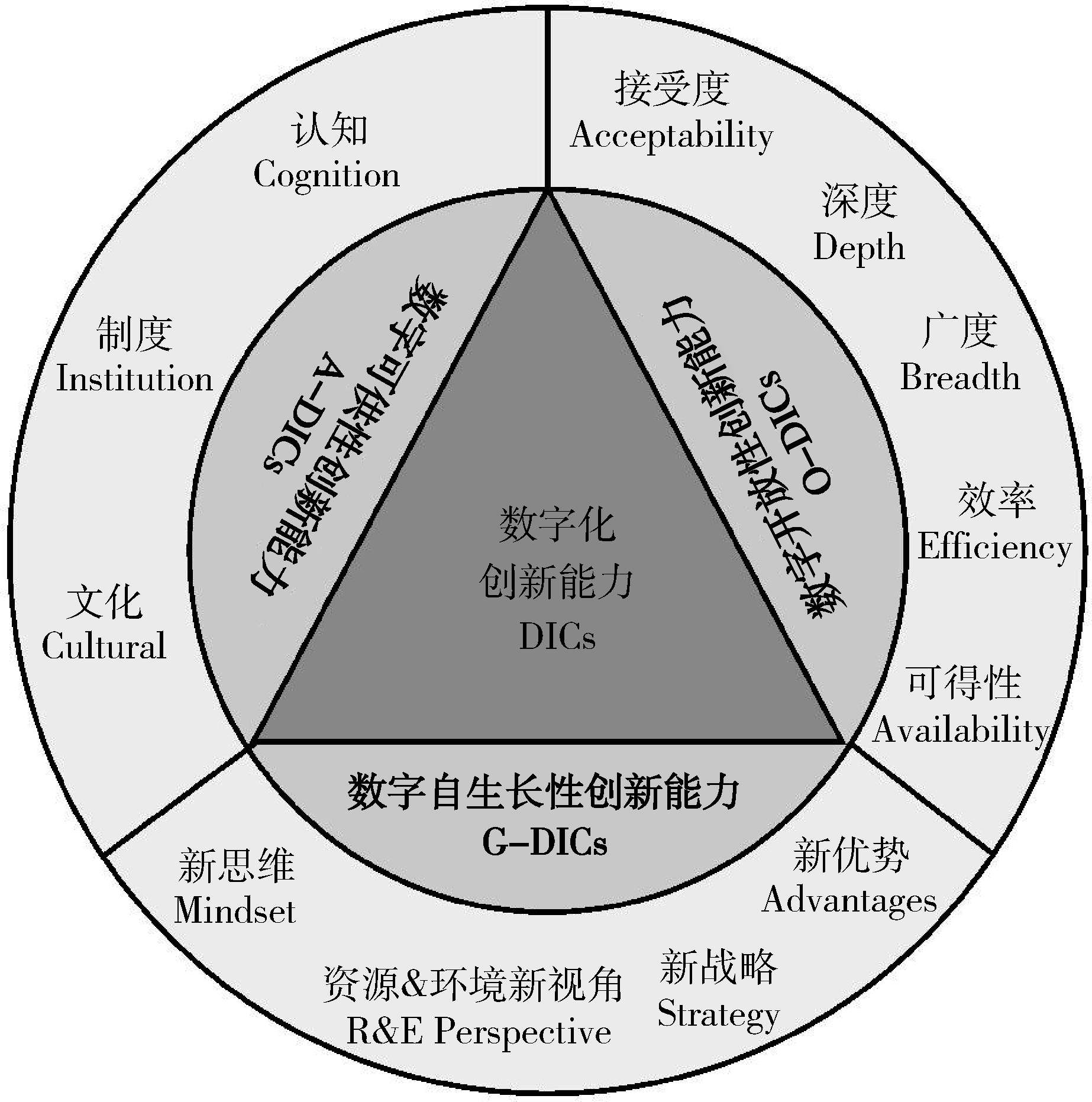
图1 数字化创新能力的结构构成
Figure 1 The structure of digitalized innovation capabilities
| 题项 | 因子载荷 | |||
|---|---|---|---|---|
| 开放性(V1) | ||||
| (KF1)数字技术开发和(或)应用提升了创新过程中的信息沟通深度 | 0.898 | |||
| (KF2)数字技术开发和(或)应用提升了创新过程中的信息沟通广度 | 0.878 | |||
| (KF3)数字技术开发和(或)应用提升了创新过程中的信息沟通效率 | 0.835 | |||
| (KF4)数字技术开发和(或)应用提升了创新过程中的外部资源获取 | 0.763 | |||
| (KF5)数字技术开发和(或)应用帮助提升市场对我们创新产出的接受度 | 0.753 | |||
| 可供性(V2) | ||||
| (NG1)数字技术开发和(或)应用帮助克服创新过程中因文化差异带来的阻碍 | 0.836 | |||
| (NG2)数字技术开发和(或)应用帮助克服创新过程中因制度差异带来的阻碍 | 0.836 | |||
| (NG3)数字技术开发和(或)应用帮助克服创新过程中因认知差异带来的阻碍 | 0.777 | |||
| 自生长性(V3) | ||||
| (SC1)数字技术开发和(或)应用为创新带来了意料之外的好处 | 0.886 | |||
| (SC2)数字技术开发和(或)应用不知不觉中拓展了我们的创新思路 | 0.852 | |||
| (SC3)数字技术开发和(或)应用不知不觉中重塑了我们的创新战略 | 0.850 | |||
| (SC4)数字技术开发和(或)应用不知不觉中优化了创新资源的利用 | 0.788 | |||
| (SC5)数字技术开发和(或)应用不知不觉中提升了创新对环境的保护 | 0.786 | |||
| 因子命名 | 开放性(V1) | 可供性(V2) | 自生长性(V3) | |
| 特征值 | 8.093 | 1.804 | 1.005 | |
| 方差贡献率 | 62.252 | 13.875 | 7.731 | |
| 累计方差贡献率 | 62.252 | 76.128 | 83.858 | |
表3 数字化创新能力问卷因子矩阵(n=205)
Table 3 The factor matrix of the DICs scale(n=205)
| 题项 | 因子载荷 | |||
|---|---|---|---|---|
| 开放性(V1) | ||||
| (KF1)数字技术开发和(或)应用提升了创新过程中的信息沟通深度 | 0.898 | |||
| (KF2)数字技术开发和(或)应用提升了创新过程中的信息沟通广度 | 0.878 | |||
| (KF3)数字技术开发和(或)应用提升了创新过程中的信息沟通效率 | 0.835 | |||
| (KF4)数字技术开发和(或)应用提升了创新过程中的外部资源获取 | 0.763 | |||
| (KF5)数字技术开发和(或)应用帮助提升市场对我们创新产出的接受度 | 0.753 | |||
| 可供性(V2) | ||||
| (NG1)数字技术开发和(或)应用帮助克服创新过程中因文化差异带来的阻碍 | 0.836 | |||
| (NG2)数字技术开发和(或)应用帮助克服创新过程中因制度差异带来的阻碍 | 0.836 | |||
| (NG3)数字技术开发和(或)应用帮助克服创新过程中因认知差异带来的阻碍 | 0.777 | |||
| 自生长性(V3) | ||||
| (SC1)数字技术开发和(或)应用为创新带来了意料之外的好处 | 0.886 | |||
| (SC2)数字技术开发和(或)应用不知不觉中拓展了我们的创新思路 | 0.852 | |||
| (SC3)数字技术开发和(或)应用不知不觉中重塑了我们的创新战略 | 0.850 | |||
| (SC4)数字技术开发和(或)应用不知不觉中优化了创新资源的利用 | 0.788 | |||
| (SC5)数字技术开发和(或)应用不知不觉中提升了创新对环境的保护 | 0.786 | |||
| 因子命名 | 开放性(V1) | 可供性(V2) | 自生长性(V3) | |
| 特征值 | 8.093 | 1.804 | 1.005 | |
| 方差贡献率 | 62.252 | 13.875 | 7.731 | |
| 累计方差贡献率 | 62.252 | 76.128 | 83.858 | |
| 模型 | χ2 | df | χ2/df | RMSEA | SRMR | CFI | TFI |
|---|---|---|---|---|---|---|---|
| 三因子模型G5 | 181.020 | 60 | 3.017 | 0.099 | 0.032 | 0.965 | 0.955 |
| 二因子模型G4 | 723.481 | 62 | 11.669 | 0.229 | 0.132 | 0.809 | 0.760 |
| 二因子模型G3 | 553.392 | 62 | 8.927 | 0.197 | 0.087 | 0.858 | 0.821 |
| 二因子模型G2 | 839.407 | 62 | 13.539 | 0.248 | 0.185 | 0.775 | 0.717 |
| 单因子模型G1 | 1152.543 | 63 | 18.294 | 0.291 | 0.170 | 0.685 | 0.610 |
表4 数字化创新能力量表的模型拟合指数(n=204)
Table 4 The factor fit index of the DICs scale(n=204)
| 模型 | χ2 | df | χ2/df | RMSEA | SRMR | CFI | TFI |
|---|---|---|---|---|---|---|---|
| 三因子模型G5 | 181.020 | 60 | 3.017 | 0.099 | 0.032 | 0.965 | 0.955 |
| 二因子模型G4 | 723.481 | 62 | 11.669 | 0.229 | 0.132 | 0.809 | 0.760 |
| 二因子模型G3 | 553.392 | 62 | 8.927 | 0.197 | 0.087 | 0.858 | 0.821 |
| 二因子模型G2 | 839.407 | 62 | 13.539 | 0.248 | 0.185 | 0.775 | 0.717 |
| 单因子模型G1 | 1152.543 | 63 | 18.294 | 0.291 | 0.170 | 0.685 | 0.610 |
| 总量表 | 题项数 | Cronbach-α系数 | 因子名称 | 题项数 | Cronbach α系数 |
|---|---|---|---|---|---|
| 数字化 创新能力 | 13 | 0.950 | 开放性V1 | 5 | 0.952 |
| 可供性V2 | 3 | 0.945 | |||
| 自生长性V3 | 5 | 0.957 |
表5 数字化创新能力量表的内部一致性系数(n=409)
Table 5 The internal consistency coefficient of the DICs scale(n=409)
| 总量表 | 题项数 | Cronbach-α系数 | 因子名称 | 题项数 | Cronbach α系数 |
|---|---|---|---|---|---|
| 数字化 创新能力 | 13 | 0.950 | 开放性V1 | 5 | 0.952 |
| 可供性V2 | 3 | 0.945 | |||
| 自生长性V3 | 5 | 0.957 |
| 结构维度 | 开放性 | 可供性 | 自生长性 |
|---|---|---|---|
| 开放性V1 | (0.828) | ||
| 可供性V2 | 0.502 | (0.817) | |
| 自生长性V3 | 0.718 | 0.594 | (0.833) |
| AVE值 | 0.685 | 0.667 | 0.694 |
| CR值 | 0.915 | 0.857 | 0.919 |
表6 数字化创新能力量表各维度相关矩阵及效度检验
Table 6 The correlation matrix and validity test of the DICs scale
| 结构维度 | 开放性 | 可供性 | 自生长性 |
|---|---|---|---|
| 开放性V1 | (0.828) | ||
| 可供性V2 | 0.502 | (0.817) | |
| 自生长性V3 | 0.718 | 0.594 | (0.833) |
| AVE值 | 0.685 | 0.667 | 0.694 |
| CR值 | 0.915 | 0.857 | 0.919 |
| 变量 | M | SD | 1 | 2 | 3 | 4 | 5 | 6 |
|---|---|---|---|---|---|---|---|---|
| 年龄 | 2.614 | 0.681 | 1 | |||||
| 司龄 | 2.829 | 1.174 | 0.383** | 1 | ||||
| 开放性 | 4.186 | 0.634 | 0.022 | 0.069 | 1 | |||
| 可供性 | 3.928 | 0.819 | 0.035 | 0.071 | 0.718** | 1 | ||
| 自生长性 | 3.944 | 0.763 | 0.036 | 0.093 | 0.502** | 0.594** | 1 | |
| 创新绩效 | 3.676 | 0.794 | 0.005 | 0.054 | 0.424** | 0.443** | 0.461** | 1 |
表7 变量的描述性分析
Table 7 Descriptive analysis of variables under research(n=409)
| 变量 | M | SD | 1 | 2 | 3 | 4 | 5 | 6 |
|---|---|---|---|---|---|---|---|---|
| 年龄 | 2.614 | 0.681 | 1 | |||||
| 司龄 | 2.829 | 1.174 | 0.383** | 1 | ||||
| 开放性 | 4.186 | 0.634 | 0.022 | 0.069 | 1 | |||
| 可供性 | 3.928 | 0.819 | 0.035 | 0.071 | 0.718** | 1 | ||
| 自生长性 | 3.944 | 0.763 | 0.036 | 0.093 | 0.502** | 0.594** | 1 | |
| 创新绩效 | 3.676 | 0.794 | 0.005 | 0.054 | 0.424** | 0.443** | 0.461** | 1 |
| 变量 | 创新绩效 | ||
|---|---|---|---|
| 模型1 | 模型2 | 模型3 | |
| 年龄 | -0.016 | -0.023 | -0.019 |
| 司龄 | 0.031 | 0.032 | 0.019 |
| 开放性 | 0.422** | ||
| 可供性 | 0.442** | ||
| 自生长性 | 0.459** | ||
| R2 | 0.180 | 0.198 | 0.212 |
| 调整R2 | 0.174 | 0.192 | 0.207 |
| △R2 | 0.177 | 0.194 | 0.209 |
| F | 29.720** | 33.253** | 36.428** |
表8 数字化创新能力对创新绩效的回归分析表
Table 8 Analysis of the regression model of DICs on innovation performance
| 变量 | 创新绩效 | ||
|---|---|---|---|
| 模型1 | 模型2 | 模型3 | |
| 年龄 | -0.016 | -0.023 | -0.019 |
| 司龄 | 0.031 | 0.032 | 0.019 |
| 开放性 | 0.422** | ||
| 可供性 | 0.442** | ||
| 自生长性 | 0.459** | ||
| R2 | 0.180 | 0.198 | 0.212 |
| 调整R2 | 0.174 | 0.192 | 0.207 |
| △R2 | 0.177 | 0.194 | 0.209 |
| F | 29.720** | 33.253** | 36.428** |
| [1] |
Nambisan S, Wright M, Feldman M. The digital transformation of innovation and entrepreneurship: Progress, challenges and key themes[J]. Research Policy, 2019, 48(8): 103773.
DOI URL |
| [2] |
Barney J, Wright M, Ketchen JR D J. The resource-based view of the firm: Ten years after 1991[J]. Journal of Management, 2001, 27(6): 625-641.
DOI URL |
| [3] |
Barney J B. Resource-based theories of competitive advantage: A ten-year retrospective on the resource-based view[J]. Journal of Management, 2001, 27(6): 643-650.
DOI URL |
| [4] | Barney J B, Clark D N. Resource-based Theory: Creating and Sustaining Competitive Advantage[M]. Oxford University Press on Demand, 2007. |
| [5] |
Conner K R. A historical comparison of resource-based theory and five schools of thought within industrial organization economics: Do we have a new theory of the firm?[J]. Journal of Management, 1991, 17(1): 121-154.
DOI URL |
| [6] |
Yoo Y, Boland R J, Lyytinen K, et al. Organizing for innovation in the digitized world[J]. Organ Sci, 2012, 23(5): 1398-1408.
DOI URL |
| [7] | Nambisan S, Lyytinen K, Majchrzak A, et al. Digital innovation management: Reinventing innovation management research in a digital world[J]. MIS Quart Manage Inf Syst, 2017, 41(1): 223-238. |
| [8] | 刘洋, 董久钰, 魏江. 数字创新管理:理论框架与未来研究[J]. 管理世界, 2020, 36(7): 198-217,9. |
| Liu Y, Dong J Y, Wei J. Digital innovation management:Theoretical framework and future research[J]. Journal of Management World, 2020, 36(7): 198-217,9. | |
| [9] | 罗兴武, 张皓, 刘洋, 等. 数字平台企业如何从事件中塑造数字创新能力——基于事件系统理论的钉钉成长案例研究[J]. 南开管理评论, 2023, 26(4): 234-247. |
| Luo X W, Zhang H, Liu Y. How platform enterprises shape digital innovation capabilities through events-A case study of enterprise growth based on event system theory[J]. Nankai Business Review, 2023, 26(4): 234-247. | |
| [10] | 康瑾, 陈凯华. 数字创新发展经济体系:框架、演化与增值效应[J]. 科研管理, 2021, 42(4): 1-10. |
| Kang J, Chen K H. Digital innovation development economic system:The framework, evolution and value creation effect[J]. Science Research Management, 2021, 42(4): 1-10. | |
| [11] |
Teece D J, Pisano G, Shuen A. Dynamic capabilities and strategic management[J]. Strategic Management Journal, 1997, 18(7): 509-533.
DOI URL |
| [12] |
Annarelli A, Battistella C, Nonino F, et al. Literature review on digitalization capabilities: Co-citation analysis of antecedents, conceptualization and consequences[J]. Technological Forecasting and Social Change, 2021, 166: 120635.
DOI URL |
| [13] | Ghosh S, Hughes M, Hodgkinson I, et al. Digital transformation of industrial businesses: A dynamic capability approach[J]. Technovation, 2022, 113. |
| [14] |
Yoo Y, Henfridsson O, Lyytinen K. Research Commentary-The new organizing logic of digital innovation: An agenda for information systems research[J]. Info Sys Research, 2010, 21(4): 724-735.
DOI URL |
| [15] | 余江, 陈凤, 王腾. 数字创新引领产业高质量发展的机制研究[J]. 创新科技, 2020, 20(1): 80-86. |
| Yu J, Chen F, Wang T. Research on the mechanisms of digital innovation leading high-quality development of industries[J] Innovation Science and Technology, 2020, 20(1): 80-86. | |
| [16] | 曲冠楠, 陈凯华, 陈劲. 颠覆性技术创新:理论源起、整合框架与发展前瞻[J]. 科研管理, 2023, 44(9): 1-9. |
| Qu G N, Chen K H, Chen J. Disruptive technovation: Origins, integrated framework, and prospects[J] Science Research Management, 2023, 44(9): 1-9. | |
| [17] |
Jahanmir S F, Cavadas J. Factors affecting late adoption of digital innovations[J]. Journal of Business Research, 2018, 88: 337-343.
DOI URL |
| [18] |
Teece D J. Explicating dynamic capabilities: The nature and microfoundations of (sustainable) enterprise performance[J]. Strategic Management Journal, 2007, 28(13): 1319-1350.
DOI URL |
| [19] |
Teece D J. Towards a capability theory of (innovating) firms: Implications for management and policy[J]. Cambridge Journal of Economics, 2017, 41(3): 693-720.
DOI URL |
| [20] | Teece D J, Leih S. Uncertainty, innovation, and dynamic capabilities: An introduction[J]. California Management Review, 2016, 58(4): 5-12. |
| [21] | Teece D J. Profiting from technological innovation: Implications for integration, collaboration, licensing and public policy[J]. Revista Brasileira De Inovacao, 2007, 6(2): 259-279. |
| [22] |
Warner K S R, Waeger M. Building dynamic capabilities for digital transformation: An ongoing process of strategic renewal[J]. Long Range Planning, 2019, 52(3): 326-349.
DOI |
| [23] |
Fichman R G, Santos B L D, Zheng Z. Digital innovation as a fundamental and powerful concept in the information systems curriculum[J]. MIS Q, 2014, 38: 329-343.
DOI URL |
| [24] |
Arora A, Athreye S, Huang C. The paradox of openness revisited: Collaborative innovation and patenting by UK innovators[J]. Research Policy, 2016, 45(7): 1352-1361.
DOI URL |
| [25] | Gibson J J. The theory of affordances[A]. Perceiving, Acting, and Knowing: Toward an Ecological Psychology[C]. Hillsdale,NJ:Lawrence Erlbaum Associates,1977:67-82. |
| [26] |
Kohli R, Melville N P. Digital innovation: A review and synthesis[J]. Information Systems Journal, 2019, 29(1): 200-223.
DOI |
| [27] | March J G. Decisions and Organizations[M]. Oxford: Blackwell, 1988. |
| [28] |
Austin R D, Devin L, Sullivan E E. Accidental innovation: Supporting valuable unpredictability in the creative process[J]. Organ Sci, 2012, 23(5): 1505-1522.
DOI URL |
| [29] | 曲冠楠, 陈凯华, 陈劲. 面向新发展格局的意义导向“创新链”管理[J]. 科学学研究, 2023, 41(1): 134-142,80. |
| Qu G N, Chen K H, Chen J. Meaning-oriented “innovation chain” management under the new development paradigm[J] Studies in Science of Science, 2023, 41(1): 134-142,80. | |
| [30] | Jonathan L Z. The generative internet[J]. Harvard Law Review, 2006, 119(7): 1974-2040. |
| [31] |
Franke N, Von Hippel E. Satisfying heterogeneous user needs via innovation toolkits: The case of Apache security software[J]. Research Policy, 2003, 32(7): 1199-1215.
DOI URL |
| [32] | Lyytinen K, Yoo Y, JR R J B. Digital product innovation within four classes of innovation networks[J]. Info Sys Jour, 2016, 26(1): 47-75. |
| [33] | Kline R B.Assumptions in structural equation modeling [A]. Handbook of Structural Equation Modeling[C]. New York, NY, US; The Guilford Press, 2012: 111-125. |
| [34] | Hair J F, Black W C, BaBin B J, et al. Multivariate Data Analysis (7th Edition)[M]. New Jersey: Prentice Hall, 2009. |
| [35] |
Welbourne T M, Johnson D E, Erez A. The role-based performance scale: Validity analysis of a theory-based measure[J]. Academy of Management Journal, 1998, 41(5): 540-555.
DOI URL |
| [1] | 曹磊 杜勇 王铁勋. 传统工艺企业如何借助数智化实现突破性创新———基于泸州老窖的案例研究[J]. 科学学研究, 2026, 44(4): 780-791. |
| [2] | 武建龙 刘禹彤 王珊珊 鲍萌萌. 在位企业如何实现颠覆性技术创新? ———基于组织惰性和动态创新能力的匹配性研究[J]. 科学学研究, 2024, 42(11): 2434-2444. |
| [3] | 刘志鹏 程燕林 代涛 李怡洁. 技术依赖形成和影响经济安全的机制研究———基于技术经济安全视角[J]. 科学学研究, 2023, 41(6): 1006-1013. |
| [4] | 张海丽 王宇凡 Michael Song. 大数据驱动创新过程提高数字创新绩效的路径[J]. 科学学研究, 2023, 41(6): 1106-1120. |
| [5] | 陈凌子 周文辉. 创业孵化平台生态优势的量表开发与检验[J]. 科学学研究, 2023, 41(5): 905-915. |
| [6] | 刘志迎 施佳蓉. 产业链技术创新量表开发[J]. 科学学研究, 2023, 41(11): 2098-2112. |
| [7] | 程聪 缪泽锋 严璐璐 陈锋. 数字技术可供性与企业数字创新价值关系研究[J]. 科学学研究, 2022, 40(5): 915-926. |
| [8] | 张羽飞 原长弘. 产学研深度融合突破关键核心技术的演进研究[J]. 科学学研究, 2022, 40(5): 852-862. |
| [9] | 尹西明 林镇阳 陈劲 林拥军. 数据要素价值化动态过程机制研究[J]. 科学学研究, 2022, 40(2): 220-229. |
| [10] | 吴伟伟 石健 刘业鑫. 技术创新责任:维度与测量[J]. 科学学研究, 2022, 40(12): 2258-2271. |
| [11] | 范柏乃 吴晓彤 李旭桦. 城市创新能力的空间分布及其影响因素研究[J]. 科学学研究, 2020, 38(8): 1473-1480. |
| [12] | 谢雅萍 陈睿君 黄丽清. 创业失败修复的内涵、维度及其测量[J]. 科学学研究, 2020, 38(6): 1076-1085. |
| [13] | 刘海兵. 创新情境、开放式创新与创新能力动态演化[J]. 科学学研究, 2019, 37(9): 1680-1693. |
| [14] | 孙耀吾 秦毓 贺石中. 高技术中小企业知识搜索对创新能力的影响[J]. 科学学研究, 2018, 36(3): 550-557. |
| [15] | 张艺 陈凯华 朱桂龙. 产学研合作与后发国家创新主体能力演变——以中国高铁产业为例[J]. 科学学研究, 2018, 36(10): 1896-1913. |
| 阅读次数 | ||||||
|
全文 |
|
|||||
|
摘要 |
|
|||||
