
- 中国科学学与科技政策研究会
- 中国科学院科技战略咨询研究院
- 清华大学科学技术与社会研究中心
ISSN 1003-2053 CN 11-1805/G3
科学学研究 ›› 2026, Vol. 44 ›› Issue (9): 1924-1934.
唐锦玥1, 罗守贵1,2, 孙雅慧3( )
收稿日期:2025-06-26
修回日期:2025-09-19
出版日期:2026-09-15
发布日期:2026-09-15
通讯作者:
孙雅慧(1995-),女,讲师,博士,E-mail:作者简介:唐锦玥(1999-),女,博士后。基金资助:
TANG Jin-yue1, LUO Shou-gui1,2, SUN Ya-hui3()
Received:2025-06-26
Revised:2025-09-19
Online:2026-09-15
Published:2026-09-15
摘要:
创新是经济增长的第一驱动力,基础研究是推动创新增长、激发突破性创新的关键来源。本文基于2008-2018年6.3万家上海市科技企业年度调查、专利申请、论文发表数据,为企业基础研究的趋势、动机与创新突破效应提供新证据。研究发现:第一,企业基础研究对技术突破具有促进作用,企业论文发表每增加1篇,突破性发明专利申请数提高0.8%。第二,基础研究的效应存在异质性,与行业的研发投入、人力资本、技术收益强度及类型相关。第三,基础研究通过知识密度增加、技术边界扩大、经济价值提高三个机制促进技术突破。本文的结论为发挥企业创新主体作用、实现科学驱动创新、加快实施创新驱动发展战略提供理论支持与政策参考。
中图分类号:
唐锦玥, 罗守贵, 孙雅慧. 企业基础研究对技术突破的影响研究[J]. 科学学研究, 2026, 44(9): 1924-1934.
TANG Jin-yue, LUO Shou-gui, SUN Ya-hui. The effects of firms' basic research on technology breakthrough[J]. Studies in Science of Science, 2026, 44(9): 1924-1934.
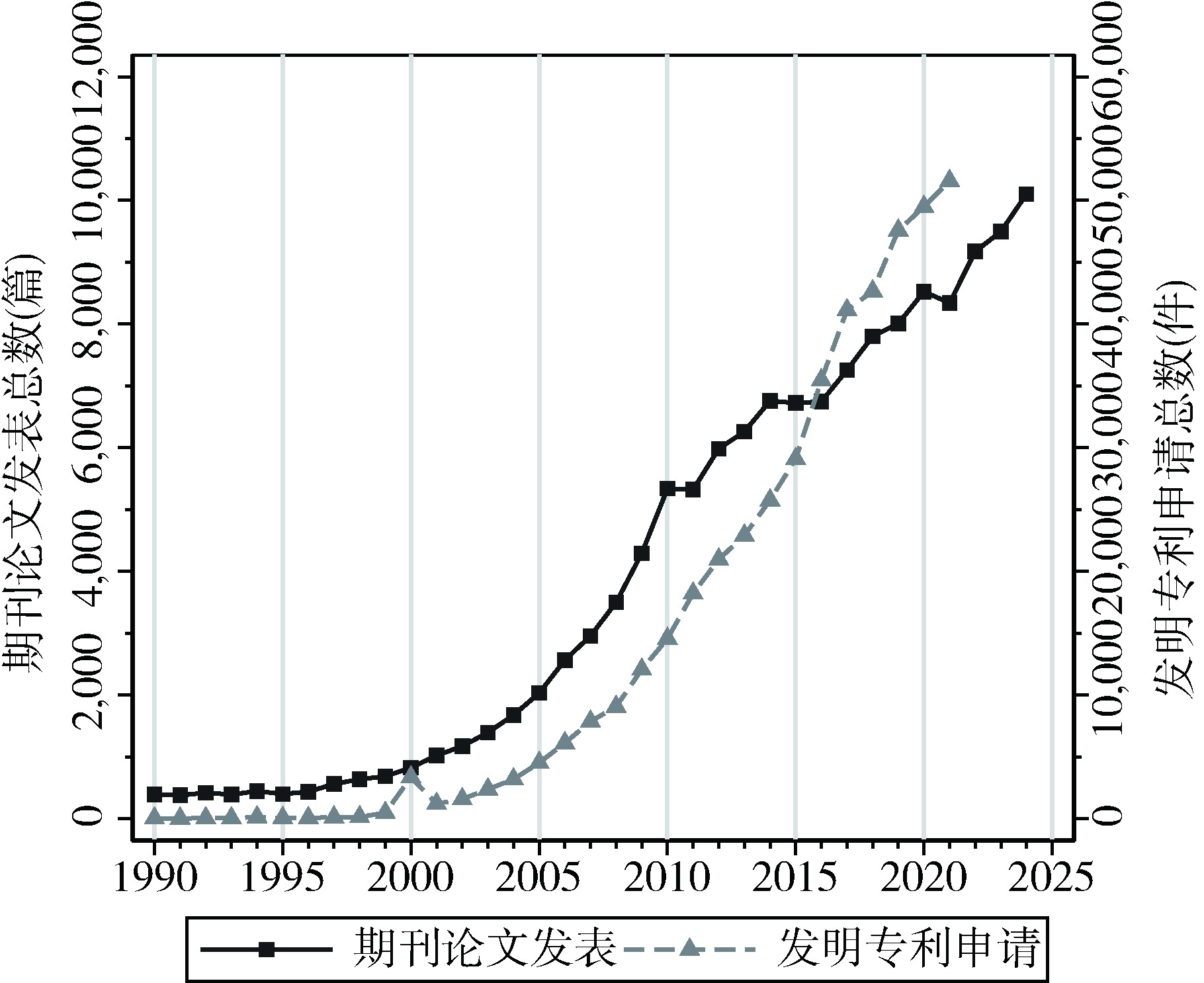
图1 企业基础研究与技术创新的时间趋势
Figure 1 Time trends of firms' basic research and technological innovation
| 变量 | 定义 | 均值 | 标准差 |
|---|---|---|---|
| Patent | 发明专利申请数(件) | 0.931 | 10.786 |
| Break | 突破性技术的发明专利申请数(件) | 0.144 | 2.107 |
| PPatent | 引用基础研究的发明专利申请数(件) | 0.219 | 2.774 |
| FCite | 发明专利申请的前向引用关系总数(次) | 0.152 | 0.976 |
| BCite | 发明专利申请的后向引用关系总数(次) | 0.187 | 1.608 |
| NField | 发明专利申请的新技术领域总数(个) | 0.406 | 2.234 |
| PField | 有新技术领域的发明专利申请数(件) | 0.511 | 3.384 |
| NRight | 发明专利申请的权利要求总项数(个) | 0.747 | 8.889 |
| WRight | 发明专利申请的权利要求总字数(字) | 25.235 | 337.682 |
| BR | 学术期刊论文发表数(篇) | 0.233 | 2.927 |
| RD | 研发支出额(百万元) | 5.384 | 56.166 |
| Emp | 总雇员(人) | 83.131 | 374.512 |
| Asset | 总资产(百万元) | 144.198 | 1894.189 |
| Debt | 总负债(百万元) | 82.351 | 2477.904 |
| Age | 企业年龄(年) | 7.795 | 5.947 |
| DA | 资产负债率 | 1.024 | 20.088 |
| ROA | 资产利润率 | -0.273 | 20.390 |
| 企业数 | 63,028 | ||
| 样本量 | 178,517 |
表1 变量定义与描述统计
Table 1 Variable definitions and descriptive statistics
| 变量 | 定义 | 均值 | 标准差 |
|---|---|---|---|
| Patent | 发明专利申请数(件) | 0.931 | 10.786 |
| Break | 突破性技术的发明专利申请数(件) | 0.144 | 2.107 |
| PPatent | 引用基础研究的发明专利申请数(件) | 0.219 | 2.774 |
| FCite | 发明专利申请的前向引用关系总数(次) | 0.152 | 0.976 |
| BCite | 发明专利申请的后向引用关系总数(次) | 0.187 | 1.608 |
| NField | 发明专利申请的新技术领域总数(个) | 0.406 | 2.234 |
| PField | 有新技术领域的发明专利申请数(件) | 0.511 | 3.384 |
| NRight | 发明专利申请的权利要求总项数(个) | 0.747 | 8.889 |
| WRight | 发明专利申请的权利要求总字数(字) | 25.235 | 337.682 |
| BR | 学术期刊论文发表数(篇) | 0.233 | 2.927 |
| RD | 研发支出额(百万元) | 5.384 | 56.166 |
| Emp | 总雇员(人) | 83.131 | 374.512 |
| Asset | 总资产(百万元) | 144.198 | 1894.189 |
| Debt | 总负债(百万元) | 82.351 | 2477.904 |
| Age | 企业年龄(年) | 7.795 | 5.947 |
| DA | 资产负债率 | 1.024 | 20.088 |
| ROA | 资产利润率 | -0.273 | 20.390 |
| 企业数 | 63,028 | ||
| 样本量 | 178,517 |
| 被解释变量 | 技术创新 | 突破性技术创新 | ||||
|---|---|---|---|---|---|---|
| 指标 | Patent | Patent | Patent | Break | Break | Break |
| (1) | (2) | (3) | (4) | (5) | (6) | |
| BR | 0.040*** | 0.026*** | 0.017*** | 0.016*** | 0.010*** | 0.008*** |
| (0.003) | (0.002) | (0.002) | (0.001) | (0.001) | (0.001) | |
| 控制变量 | 否 | 是 | 是 | 否 | 是 | 是 |
| 企业固定效应 | 否 | 否 | 是 | 否 | 否 | 是 |
| 年份固定效应 | 否 | 否 | 是 | 否 | 否 | 是 |
| 样本量 | 178,517 | 169,847 | 146,203 | 178,517 | 169,847 | 146,203 |
| 解释度 | 0.040 | 0.122 | 0.679 | 0.034 | 0.119 | 0.606 |
表2 企业基础研究对技术突破的影响效应
Table 2 Effects of firms' basic research on technological breakthroughs
| 被解释变量 | 技术创新 | 突破性技术创新 | ||||
|---|---|---|---|---|---|---|
| 指标 | Patent | Patent | Patent | Break | Break | Break |
| (1) | (2) | (3) | (4) | (5) | (6) | |
| BR | 0.040*** | 0.026*** | 0.017*** | 0.016*** | 0.010*** | 0.008*** |
| (0.003) | (0.002) | (0.002) | (0.001) | (0.001) | (0.001) | |
| 控制变量 | 否 | 是 | 是 | 否 | 是 | 是 |
| 企业固定效应 | 否 | 否 | 是 | 否 | 否 | 是 |
| 年份固定效应 | 否 | 否 | 是 | 否 | 否 | 是 |
| 样本量 | 178,517 | 169,847 | 146,203 | 178,517 | 169,847 | 146,203 |
| 解释度 | 0.040 | 0.122 | 0.679 | 0.034 | 0.119 | 0.606 |
| 被解释变量 | 突破性技术创新 | |||||
|---|---|---|---|---|---|---|
| 指标 | Break2 | Break | Break | Break | Paper | Break |
| 测度 | 自然对数 | 反正弦对数 | 计数 | 自然对数 | 计数 | 自然对数 |
| (1) | (2) | (3) | (4) | (5) | (6) | |
| BR | 0.004*** | 0.011*** | 0.032*** | 0.009*** | 0.013*** | |
| (0.001) | (0.001) | (0.007) | (0.001) | (0.003) | ||
| IV | 0.079*** | |||||
| (0.011) | ||||||
| 控制变量 | 是 | 是 | 是 | 是 | 是 | 是 |
| 企业固定效应 | 是 | 是 | 是 | 是 | 是 | 是 |
| 年份固定效应 | 是 | 是 | 是 | 是 | 是 | |
| 行政区-行业-年份固定效应 | 是 | |||||
| 样本量 | 146,203 | 146,203 | 146,203 | 145,723 | 146,203 | 146,203 |
| 解释度 | 0.568 | 0.596 | 0.798 | 0.613 | 0.883 | 0.009 |
表3 稳健性检验
Table 3 Robustness checks
| 被解释变量 | 突破性技术创新 | |||||
|---|---|---|---|---|---|---|
| 指标 | Break2 | Break | Break | Break | Paper | Break |
| 测度 | 自然对数 | 反正弦对数 | 计数 | 自然对数 | 计数 | 自然对数 |
| (1) | (2) | (3) | (4) | (5) | (6) | |
| BR | 0.004*** | 0.011*** | 0.032*** | 0.009*** | 0.013*** | |
| (0.001) | (0.001) | (0.007) | (0.001) | (0.003) | ||
| IV | 0.079*** | |||||
| (0.011) | ||||||
| 控制变量 | 是 | 是 | 是 | 是 | 是 | 是 |
| 企业固定效应 | 是 | 是 | 是 | 是 | 是 | 是 |
| 年份固定效应 | 是 | 是 | 是 | 是 | 是 | |
| 行政区-行业-年份固定效应 | 是 | |||||
| 样本量 | 146,203 | 146,203 | 146,203 | 145,723 | 146,203 | 146,203 |
| 解释度 | 0.568 | 0.596 | 0.798 | 0.613 | 0.883 | 0.009 |
| 被解释变量 | 突破性技术创新(Break) | |||||
|---|---|---|---|---|---|---|
| 调节变量 | 行业研发投入强度 | 行业人力资本强度 | 行业技术收益强度 | |||
| 调节指标 | IRD | IRDEmp | IEEmp | ISEmp | ITPro | ITSer |
| (1) | (2) | (3) | (4) | (5) | (6) | |
| BR | 0.009*** | 0.006*** | 0.005*** | 0.009*** | -0.017** | 0.016*** |
| (0.001) | (0.002) | (0.001) | (0.001) | (0.007) | (0.004) | |
| BR × M | -0.009 | 0.007*** | 0.041*** | -0.014** | 0.001*** | -0.001* |
| (0.031) | (0.002) | (0.011) | (0.007) | (0.000) | (0.000) | |
| 控制变量 | 是 | 是 | 是 | 是 | 是 | 是 |
| 企业固定效应 | 是 | 是 | 是 | 是 | 是 | 是 |
| 行业-年份固定效应 | 是 | 是 | 是 | 是 | 是 | 是 |
| 样本量 | 146,196 | 146,196 | 146,196 | 146,196 | 107,422 | 146,196 |
| 解释度 | 0.606 | 0.607 | 0.607 | 0.607 | 0.630 | 0.606 |
表4 异质性检验
Table 4 Heterogeneity analysis
| 被解释变量 | 突破性技术创新(Break) | |||||
|---|---|---|---|---|---|---|
| 调节变量 | 行业研发投入强度 | 行业人力资本强度 | 行业技术收益强度 | |||
| 调节指标 | IRD | IRDEmp | IEEmp | ISEmp | ITPro | ITSer |
| (1) | (2) | (3) | (4) | (5) | (6) | |
| BR | 0.009*** | 0.006*** | 0.005*** | 0.009*** | -0.017** | 0.016*** |
| (0.001) | (0.002) | (0.001) | (0.001) | (0.007) | (0.004) | |
| BR × M | -0.009 | 0.007*** | 0.041*** | -0.014** | 0.001*** | -0.001* |
| (0.031) | (0.002) | (0.011) | (0.007) | (0.000) | (0.000) | |
| 控制变量 | 是 | 是 | 是 | 是 | 是 | 是 |
| 企业固定效应 | 是 | 是 | 是 | 是 | 是 | 是 |
| 行业-年份固定效应 | 是 | 是 | 是 | 是 | 是 | 是 |
| 样本量 | 146,196 | 146,196 | 146,196 | 146,196 | 107,422 | 146,196 |
| 解释度 | 0.606 | 0.607 | 0.607 | 0.607 | 0.630 | 0.606 |
| 机制 | 基础研究支撑 | 知识密度增加 | 技术边界扩大 | 经济价值提高 | ||||
|---|---|---|---|---|---|---|---|---|
| 被解释变量 | 产生引用基础 研究的专利 | 引用基础研究 的专利数 | 前向引用 关系数 | 后向引用 关系数 | 专利中的新 技术领域数 | 有新技术领 域的专利数 | 权利要求 项数 | 权利要求 字数 |
| 指标 | DPatent | PPatent | FCite | BCite | NField | PField | NRight | WRight |
| (1) | (2) | (3) | (4) | (5) | (6) | (7) | (8) | |
| BR | 0.006*** | 0.013*** | 0.001*** | 0.001*** | 0.014*** | 0.014*** | 0.003* | 0.007** |
| (0.001) | (0.001) | (0.000) | (0.000) | (0.002) | (0.002) | (0.002) | (0.003) | |
| 控制变量 | 是 | 是 | 是 | 是 | 是 | 是 | 是 | 是 |
| 企业固定效应 | 是 | 是 | 是 | 是 | 是 | 是 | 是 | 是 |
| 年份固定效应 | 是 | 是 | 是 | 是 | 是 | 是 | 是 | 是 |
| 样本量 | 146,203 | 146,203 | 146,203 | 146,203 | 146,203 | 146,203 | 146,203 | 146,203 |
| 解释度 | 0.475 | 0.612 | 0.281 | 0.281 | 0.597 | 0.607 | 0.299 | 0.296 |
表5 企业基础研究对技术突破的影响机制
Table 5 Mechanisms analysis
| 机制 | 基础研究支撑 | 知识密度增加 | 技术边界扩大 | 经济价值提高 | ||||
|---|---|---|---|---|---|---|---|---|
| 被解释变量 | 产生引用基础 研究的专利 | 引用基础研究 的专利数 | 前向引用 关系数 | 后向引用 关系数 | 专利中的新 技术领域数 | 有新技术领 域的专利数 | 权利要求 项数 | 权利要求 字数 |
| 指标 | DPatent | PPatent | FCite | BCite | NField | PField | NRight | WRight |
| (1) | (2) | (3) | (4) | (5) | (6) | (7) | (8) | |
| BR | 0.006*** | 0.013*** | 0.001*** | 0.001*** | 0.014*** | 0.014*** | 0.003* | 0.007** |
| (0.001) | (0.001) | (0.000) | (0.000) | (0.002) | (0.002) | (0.002) | (0.003) | |
| 控制变量 | 是 | 是 | 是 | 是 | 是 | 是 | 是 | 是 |
| 企业固定效应 | 是 | 是 | 是 | 是 | 是 | 是 | 是 | 是 |
| 年份固定效应 | 是 | 是 | 是 | 是 | 是 | 是 | 是 | 是 |
| 样本量 | 146,203 | 146,203 | 146,203 | 146,203 | 146,203 | 146,203 | 146,203 | 146,203 |
| 解释度 | 0.475 | 0.612 | 0.281 | 0.281 | 0.597 | 0.607 | 0.299 | 0.296 |
| [1] |
Gersbach H, Schetter U, Schmassmann S. From local to global: A theory of public basic research in a globalized world[J]. European Economic Review, 2023, 160: 104530.
DOI URL |
| [2] |
Nelson R R. The simple economics of basic scientific research[J]. Journal of Political Economy, 1959, 67(3): 297-306.
DOI URL |
| [3] |
Iaria A, Schwarz C, Waldinger F. Frontier knowledge and scientific production: Evidence from the collapse of international science[J]. The Quarterly Journal of Economics, 2018, 133(2): 927-991.
DOI URL |
| [4] |
Partha D, David P A. Toward a new economics of science[J]. Research Policy, 1994, 23(5): 487-521.
DOI URL |
| [5] |
Akcigit U, Hanley D, Serrano-Velarde N. Back to basics: Basic research spillovers, innovation policy, and growth[J]. The Review of Economic Studies, 2021, 88(1): 1-43.
DOI URL |
| [6] |
Marchiori C, Minelli E. Talent, basic research and growth[J]. Journal of Economic Theory, 2023, 213: 105721.
DOI URL |
| [7] |
Salter A J, Martin B R. The economic benefits of publicly funded basic research: A critical review[J]. Research Policy, 2001, 30(3): 509-532.
DOI URL |
| [8] |
Arora A, Belenzon S, Sheer L. Knowledge spillovers and corporate investment in scientific research[J]. American Economic Review, 2021, 111(3): 871-898.
DOI URL |
| [9] | 贺俊, 陶思宇, 李伟, 等. 中国企业开展基础研究的特征事实与政策需求——基于763家企业的问卷调查分析[J]. 科学学研究, 2025, 43(3): 477-487. |
| He J, Tao S Y, Li W, et al. Characteristic facts and policy needs of Chinese enterprises to conduct basic research —An analysis based on a questionnaire survey of 763 enterprises[J]. Studies in Science of Science, 2025, 43(3): 477-487. | |
| [10] |
Rosenberg N. Why do firms do basic research (with their own money)[J]. Research Policy, 1990, 19(2): 165-174.
DOI URL |
| [11] |
Tijssen R J W. Is the commercialisation of scientific research affecting the production of public knowledge? Global trends in the output of corporate research articles[J]. Research Policy, 2004, 33(5): 709-733.
DOI URL |
| [12] |
Arora A, Belenzon S, Patacconi A. The decline of science in corporate R&D[J]. Strategic Management Journal, 2018, 39(1): 3-32.
DOI URL |
| [13] |
Hicks D. Published papers, tacit competencies and corporate management of the public/private character of knowledge[J]. Industrial and Corporate Change, 1995, 4(2): 401-424.
DOI URL |
| [14] |
Hsu D H, Hsu P H, Zhao Q. Rich on paper? Chinese firms' academic publications, patents, and market value[J]. Research Policy, 2021, 50(9): 104319.
DOI URL |
| [15] | 刁海璨. 企业基础研究与新质生产力培育[J]. 数量经济技术经济研究, 2025, 42(3): 91-110. |
| Diao H C. Analysis of the impact pathways of enterprise basic research on new quality productive forces[J]. Journal of Quantitative & Technological Economics, 2025, 42(3): 91-110. | |
| [16] | 龚辰皎, 闵超, 赵毅. 基础研究对科学突破的影响——以生物医药企业为例[J]. 科学学研究, 2025, 43(1): 111-124. |
| Gong C J, Min C, Zhao Y. The effect of basic research on scientific breakthroughs: Evidence from biomedical firms[J]. Studies in Science of Science, 2025, 43(1): 111-124. | |
| [17] | 张晓飞, 孙玉涛, 王茜. 基础研究对企业创新绩效的影响机制和边界[J]. 科研管理, 2025, 46(1): 114-122. |
| Zhang X F, Sun Y T, Wang Q. Influence mechanism and boundary of basic research on the innovation performance of enterprises[J]. Science Research Management, 2025, 46(1): 114-122. | |
| [18] |
Colombo M G, Guerini M, Hoisl K, et al. The dark side of signals: Patents protecting radical inventions and venture capital investments[J]. Research Policy, 2023, 52(5): 104741.
DOI URL |
| [19] |
Kroll H, Schiller D. Establishing an interface between public sector applied research and the Chinese enterprise sector: Preparing for 2020[J]. Technovation, 2010, 30(2): 117-129.
DOI URL |
| [20] |
Pavitt K. What makes basic research economically useful?[J]. Research Policy, 1991, 20(2): 109-119.
DOI URL |
| [21] |
Zellner C. The economic effects of basic research: Evidence for embodied knowledge transfer via scientists' migration[J]. Research Policy, 2003, 32(10): 1881-1895.
DOI URL |
| [22] |
Capponi G, Martinelli A, Nuvolari A. Breakthrough innovations and where to find them[J]. Research Policy, 2022, 51(1): 104376.
DOI URL |
| [23] | 孙雅慧, 时省, 彭飞, 等. 研发补贴与渐进式创新锁定:基于机器学习的专利文本分析[J]. 经济研究, 2024, 59(11): 89-105. |
| Sun Y H, Shi X, Peng F, et al. R&D subsidies and incremental innovation lock-in: A machine learning-based patent text analysis[J]. Economic Research Journal, 2024, 59(11): 89-105. | |
| [24] | 张峰, 朱蕾, 许治. 逆向工程、知识创造与企业突破性创新——基于制度环境的调节效应研究[J]. 科学学与科学技术管理, 2024, 45(12): 138-150. |
| Zhang F, Zhu L, Xu Z. Reverse engineering, knowledge creation, and breakthrough innovations: The moderating role of institutional environment[J]. Science of Science and Management of S.& T., 2024, 45(12): 138-150. | |
| [25] | 贾军, 张卓. 企业技术范围选择:技术多元化还是技术专业化[J]. 科学学与科学技术管理, 2012, 33(11): 124-133. |
| Jia J, Zhang Z. Enterprise technological scope choice: Technological diversification or technological specialization[J]. Science of Science and Management of S.& T., 2012, 33(11): 124-133. | |
| [26] | 李长英, 赵忠涛. 技术多样化对企业创新数量和创新质量的影响研究[J]. 经济学动态, 2020(6): 15-29. |
| Li C Y, Zhao Z T. The impact of technology diversifications on the innovation quantity and quality of firms[J]. Economic Perspectives, 2020(6): 15-29. | |
| [27] | 周煊, 程立茹, 王皓. 技术创新水平越高企业财务绩效越好吗?——基于16年中国制药上市公司专利申请数据的实证研究[J]. 金融研究, 2012(8): 166-179. |
| Zhou X, Cheng L R, Wang H. Is higher the level of technological innovation, better the financial performance?[J]. Journal of Financial Research, 2012(8): 166-179. | |
| [28] | 吴淑娥, 仲伟周, 卫剑波, 等. 融资来源、现金持有与研发平滑——来自我国生物医药制造业的经验证据[J]. 经济学(季刊), 2016, 15(2): 745-766. |
| Wu S E, Zhong W Z, Wei J B, et al. Financing sources, cash holdings and R&D smoothing: Evidence from the Biomedical manufacturing[J]. China Economic Quarterly, 2016, 15(2): 745-766. | |
| [29] |
Rotolo D, Camerani R, Grassano N, et al. Why do firms publish? A systematic literature review and a conceptual framework[J]. Research Policy, 2022, 51(10): 104606.
DOI URL |
| [30] | 陈茜, 毛进, 马亚雪, 等. 创新型企业的论文与专利关联性研究——以基因工程领域为例[J]. 科学学研究, 2023, 41(3): 565-576. |
| Chen Q, Mao J, Ma Y X, et al. Research on the linkage between papers and patents in innovation-oriented enterprises —Take the field of genetic engineering[J]. Studies in Science of Science, 2023, 41(3): 565-576. | |
| [31] |
Belenzon S. Cumulative innovation and market value: Evidence from patent citations[J]. The Economic Journal, 2012, 122(559): 265-285.
DOI URL |
| [32] | Trajtenberg M. A penny for your quotes: Patent citations and the value of innovations[J]. The Rand Journal of Economics, 1990: 172-187. |
| [33] |
Chen J, Roth J. Logs with zeros? Some problems and solutions[J]. The Quarterly Journal of Economics, 2024, 139(2): 891-936.
DOI URL |
| [34] | 李玉花, 林雨昕, 李丹丹. 人工智能技术应用如何影响企业创新[J]. 中国工业经济, 2024(10): 155-173. |
| Li Y H, Lin Y X, Li D D. How does the application of AI technologies affect firm innovation[J]. China Industrial Economics, 2024(10): 155-173. | |
| [35] | 唐锦玥, 罗守贵. 智能产品制造与企业价值链分工位置攀升[J]. 研究与发展管理, 2023, 35(6): 60-70. |
| Tang J Y, Luo S G. Intelligent product manufacturing and rising position of division of labor in the enterprise value chain[J]. R&D Management, 2023, 35(6): 60-70. | |
| [36] |
Aghion P, Howitt P, Prantl S. Patent rights, product market reforms, and innovation[J]. Journal of Economic Growth, 2015, 20: 223-262.
DOI URL |
| [1] | 左勇华, 匡慧姝, 刘政, 余龙. 知识产权示范城市推动了数字协同创新吗?[J]. 科学学研究, 2026, 44(9): 1911-1923. |
| [2] | 冯程程 闫文军 肖尤丹. 地方财政科技支出对区域创新能力的影响研究[J]. 科学学研究, 2026, 44(8): 1745-1755. |
| [3] | 姚海琳 黄琼 耿红军. 链主企业赋能链员企业关键核心技术突破研究[J]. 科学学研究, 2026, 44(7): 1466-1477. |
| [4] | 崔林蔚, 杨嘉敏, 陈悦, 杨淳. 颠覆性科研成果生成的影响因素探究——以天文学为例[J]. 科学学研究, 2026, 44(3): 610-620. |
| [5] | 汤超颖 徐家冰 毛适博. 两类科技人才成长环境差异性的模糊组态分析[J]. 科学学研究, 2024, 42(8): 1656-1665. |
| [6] | 丁雪辰 杨萍 柳卸林. 科学关联度、政府创新补助与企业绩效———基于我国 ICT 企业的实证研究[J]. 科学学研究, 2024, 42(5): 1098-1110. |
| [7] | 吴刚, 陈中飞, 汪锋, 朱战国, 刘作仪. 管理科学面向国家重大需求的科学问题凝练[J]. 科学学研究, 2024, 42(1): 118-125. |
| [8] | 梁婧姝, 刘涛雄. 企业创新韧性及风险投资的影响:理论与实证[J]. 科学学研究, 2024, 42(1): 205-215. |
| [9] | 柳卸林 杨培培 常馨之. 问题导向的基础研究与产业突破性创新[J]. 科学学研究, 2023, 41(11): 2062-2072. |
| [10] | 王海燕 徐君言 李玲娟. 基础研究经费投入现状与统计口径研究[J]. 科学学研究, 2023, 41(10): 1812-1821. |
| [11] | 顾洁 胡雯 马双. 云计算产业空间格局、集聚模式与创新效应研究[J]. 科学学研究, 2022, 40(4): 619-631. |
| [12] | 黄键斌 宋铁波 姚浩. 智能制造政策能否提升企业全要素生产率?[J]. 科学学研究, 2022, 40(3): 433-442. |
| [13] | 吴松强 黄盼盼 蔡文洁 王雨悦. 知识溢出与先进制造业集群成长——企业创新关联的中介效应研究[J]. 科学学研究, 2022, 40(3): 516-524. |
| [14] | 臧树伟 陈红花 梅亮. 能力演化、制度供给与企业突破性创新[J]. 科学学研究, 2021, 39(5): 930-939. |
| [15] | 阳镇 凌鸿程 陈劲. 经济政策不确定性、企业社会责任与企业技术创新[J]. , 2021, 39(3): 0-0. |
| 阅读次数 | ||||||
|
全文 |
|
|||||
|
摘要 |
|
|||||
