
- 中国科学学与科技政策研究会
- 中国科学院科技战略咨询研究院
- 清华大学科学技术与社会研究中心
ISSN 1003-2053 CN 11-1805/G3
科学学研究 ›› 2026, Vol. 44 ›› Issue (6): 1217-1228.
张昊男1, 王皓月1, 邢蕊1( ), 朱方伟1,2, 高艳虹1
收稿日期:2025-06-23
修回日期:2025-12-05
出版日期:2026-06-15
发布日期:2026-06-15
通讯作者:
邢蕊(1983-),女,副教授,博士, E-mail:作者简介:张昊男(2000-),男,博士研究生。基金资助:
ZHANG Hao-nan1, WANG Hao-yue1, XING Rui1(), ZHU Fang-wei1,2, GAO Yan-hong1
Received:2025-06-23
Revised:2025-12-05
Online:2026-06-15
Published:2026-06-15
摘要:
原始创新中科学研究和技术研发作为关键组成和始点,其二者的正向反馈是保证创新可持续性的重要机制。尽管已有研究从知识流动角度证明了二者间的互通性,但缺乏关于其双向演进的实证检验。基于此,本研究聚焦新能源汽车产业,通过动态结构方程模型对42家企业2015-2024年10年间的论文和专利数据展开分析,以挖掘正反馈效应。结果显示:企业科学研究和技术研发互为因果且形成正反馈闭环;科学研究质量和技术研发广度在双向演进中发挥中介效应;合作强度(科研、技术)交叉调节双向迭代路径,证实了产学研合作在科研和技术转移间的知识补充效应。本研究证实了原始创新体系中科学研究与技术研发间持续互动和双向涌现的核心机制,为原始创新可持续性发展提供新的理论视角。
中图分类号:
张昊男, 王皓月, 邢蕊, 朱方伟, 高艳虹. 原始创新中科学研究与技术研发迭代机制研究[J]. 科学学研究, 2026, 44(6): 1217-1228.
ZHANG Hao-nan, WANG Hao-yue, XING Rui, ZHU Fang-wei, GAO Yan-hong. Research on the iterative mechanism between scientific research and technology R&D in original innovation[J]. Studies in Science of Science, 2026, 44(6): 1217-1228.
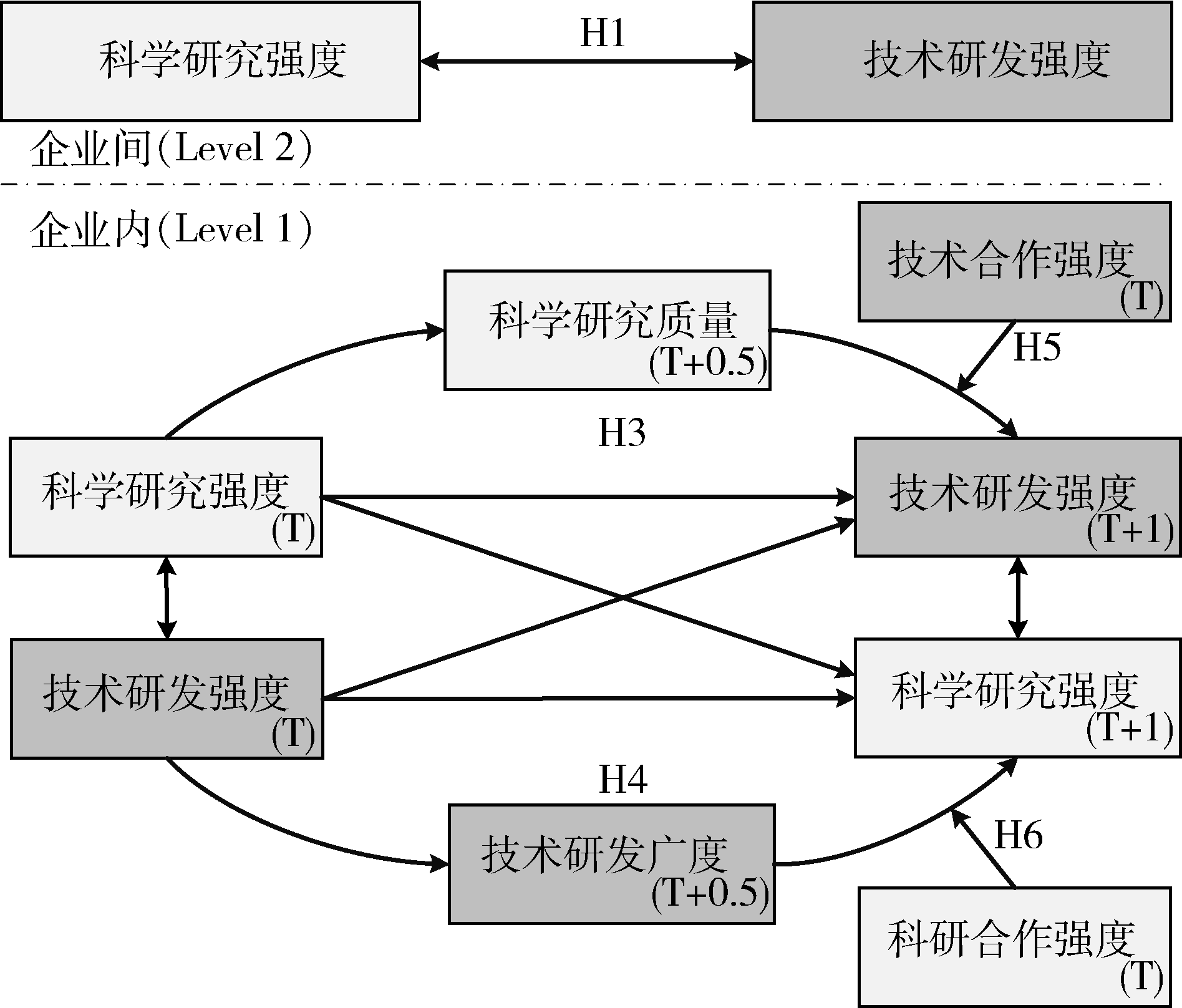
图1 研究模型
Figure 1 Research model
| 研究变量 | 1 | 2 | 3 | 4 | 5 | 6 | 7 |
|---|---|---|---|---|---|---|---|
| 1企业研发投入 | 0.934 | 0.552 | 0.571 | 0.384 | 0.351 | 0.336 | 0.401 |
| 2技术研发强度 | 0.753*** | 0.942 | 0.524 | 0.497 | 0.338 | 0.602 | 0.339 |
| 3科学研究强度 | 0.684*** | 0.324*** | 0.953 | 0.515 | 0.402 | 0.357 | 0.504 |
| 4技术合作强度 | 0.251*** | 0.537*** | 0.438*** | 0.926 | 0.611 | 0.527 | 0.418 |
| 5科研合作强度 | 0.206*** | 0.201*** | 0.457*** | 0.462*** | 0.923 | 0.498 | 0.704 |
| 6技术研发广度 | 0.455*** | 0.336*** | 0.388*** | 0.561*** | 0.242*** | 0.937 | 0.282 |
| 7科学研究质量 | 0.270*** | 0.304*** | 0.603*** | 0.206*** | 0.552*** | 0.113** | 0.928 |
表1 变量间相关系数计算结果
Table 1 Calculation results of correlation coefficients between variables
| 研究变量 | 1 | 2 | 3 | 4 | 5 | 6 | 7 |
|---|---|---|---|---|---|---|---|
| 1企业研发投入 | 0.934 | 0.552 | 0.571 | 0.384 | 0.351 | 0.336 | 0.401 |
| 2技术研发强度 | 0.753*** | 0.942 | 0.524 | 0.497 | 0.338 | 0.602 | 0.339 |
| 3科学研究强度 | 0.684*** | 0.324*** | 0.953 | 0.515 | 0.402 | 0.357 | 0.504 |
| 4技术合作强度 | 0.251*** | 0.537*** | 0.438*** | 0.926 | 0.611 | 0.527 | 0.418 |
| 5科研合作强度 | 0.206*** | 0.201*** | 0.457*** | 0.462*** | 0.923 | 0.498 | 0.704 |
| 6技术研发广度 | 0.455*** | 0.336*** | 0.388*** | 0.561*** | 0.242*** | 0.937 | 0.282 |
| 7科学研究质量 | 0.270*** | 0.304*** | 0.603*** | 0.206*** | 0.552*** | 0.113** | 0.928 |
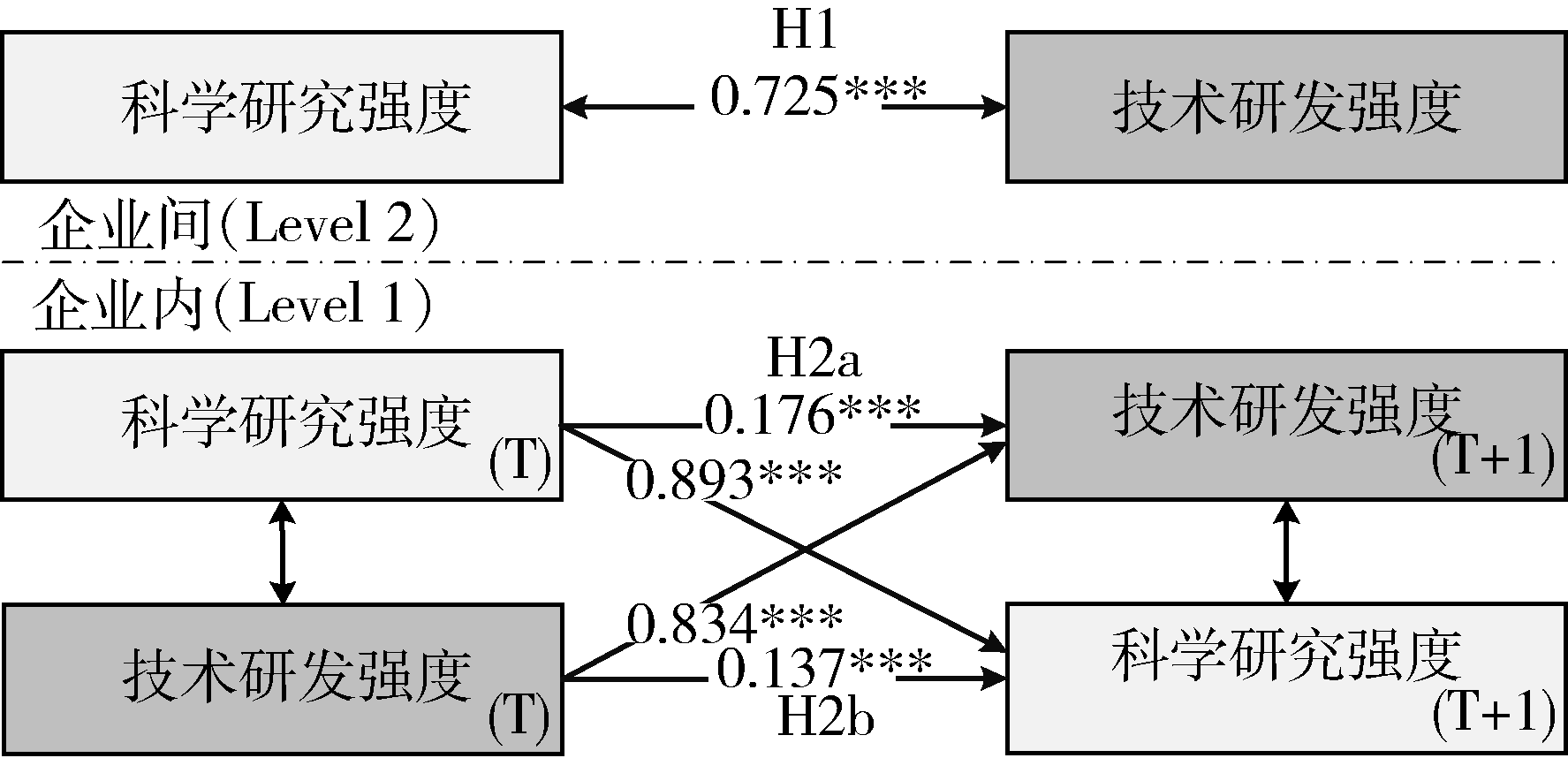
图2 DSEM主效应结果
Figure 2 Main effect results of DSEM
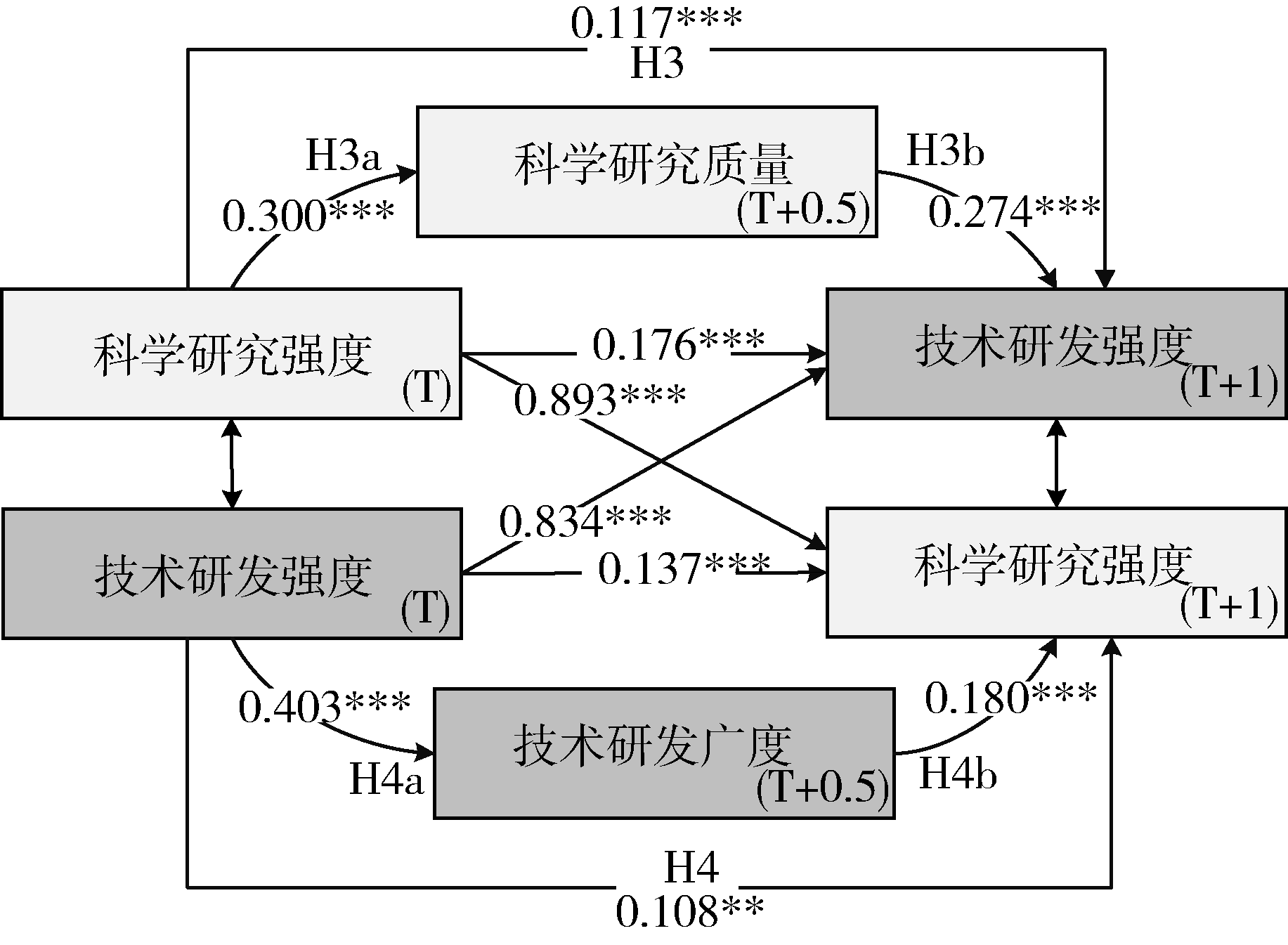
图3 DSEM中介效应结果
Figure 3 Mediating effect results of DSEM
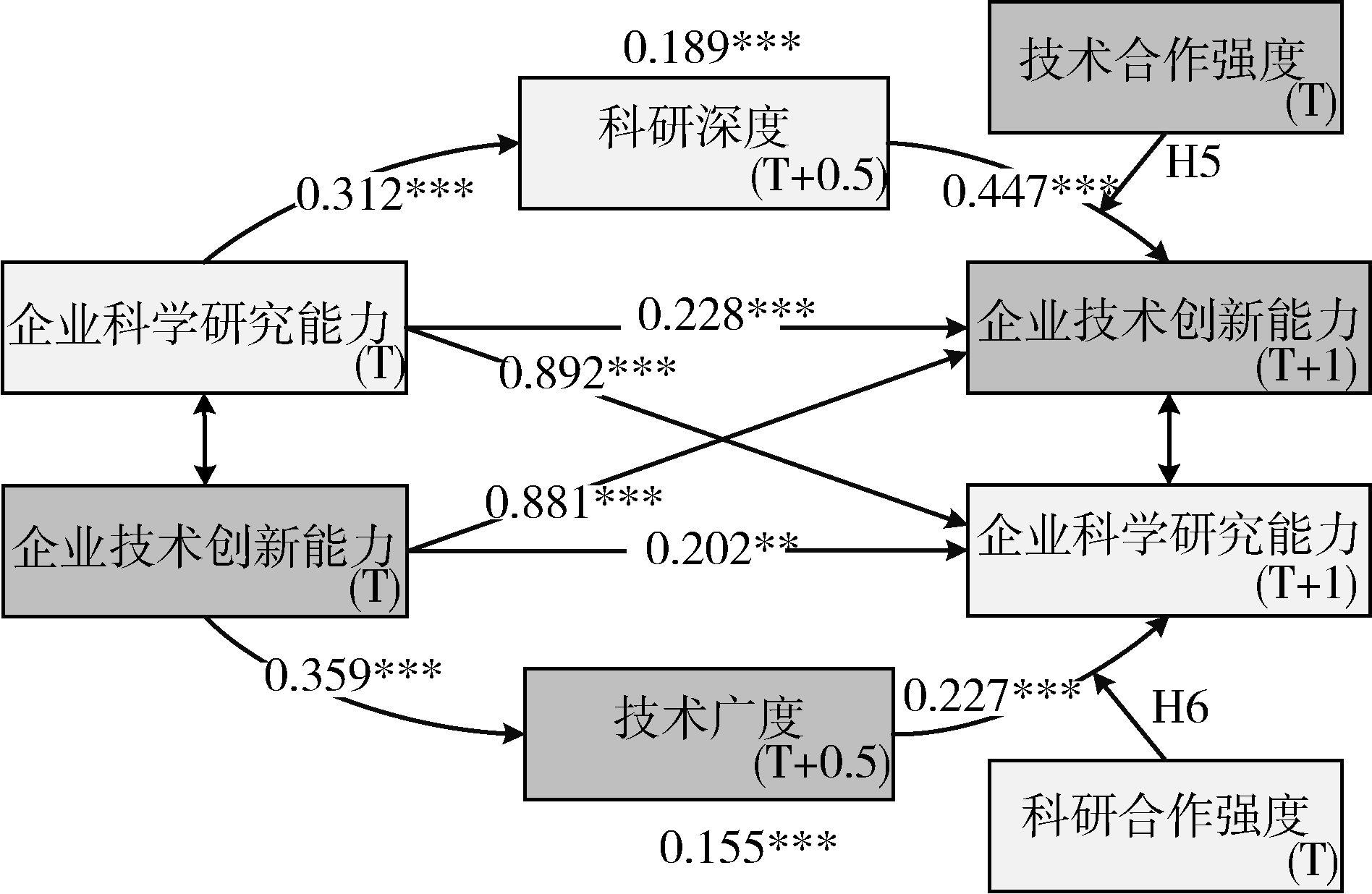
图4 合作强度DSEM调节效应结果
Figure 4 Moderating effect results of cooperation intensity in DSEM
| 关系 | 标准化系数结果 | ||
|---|---|---|---|
| 效应值 | 标准误差 | 95%置信区间 | |
| 直接效应(Level 1) | |||
| 科学研究强度(t0)→技术研发强度(t1) | 0.176 | 0.077 | [0.076,0.313] |
| 技术研发强度(t0)→科学研究强度(t1) | 0.137 | 0.085 | [0.048,0.217] |
| 自回归效应(Level 1) | |||
| 科学研究强度(t0)→科学研究强度(t1) | 0.893 | 0.040 | [0.802,0.954] |
| 技术研发强度(t0)→技术研发强度(t1) | 0.834 | 0.074 | [0.670,0.960] |
| 科学研究质量中介效应(Level 1) | |||
| 科学研究强度(t0)→科学研究质(t0.5) | 0.300 | 0.036 | [0.228,0.371] |
| 科学研究质量(t0.5)→技术研发强度(t1) | 0.274 | 0.182 | [0.070,0.647] |
| 科学研究强度→科学研究质量→技术研发强度(间接效应) | 0.117 | 0.067 | [0.029,0.190] |
| 技术研发广度中介效应(Level 1) | |||
| 技术研发强度(t0)→技术研发广度(t0.5) | 0.403 | 0.230 | [0.105,0.781] |
| 技术研发广度(t0.5)→企业科学研究强度(t1) | 0.180 | 0.104 | [0.090,0.247] |
| 技术研发强度→技术研发广度→科学研究强度(间接效应) | 0.108 | 0.085 | [0.016,0.163] |
| 技术合作强度调节效应(Level 1) | |||
| 科学研究强度(t0)→科学研究质量(t0.5) | 0.312 | 0.033 | [0.087,0.582] |
| 技术合作强度(t0) *科学研究质量(t0.5)→技术研发强度(t1) | 0.447 | 0.036 | [0.065,0.835] |
| 科学研究强度→科学研究质量→技术研发强度(间接效应) | 0.189 | 0.031 | [0.056,0.315] |
| 科学研究强度→科学研究质量→技术研发强度(间接效应差异) | 0.097 | 0.028 | [0.029,0.141] |
| 科研合作强度调节效应(Level 1) | |||
| 企业技术研发强度(t0) →技术研发广度(t0.5) | 0.359 | 0.048 | [0.116,0.575] |
| 科研合作强度(t0) *技术研发广度(t0.5)→科学研究强度(t1) | 0.227 | 0.064 | [0.104,0.445] |
| 技术研发强度→技术研发广度→科学研究强度(间接) | 0.155 | 0.024 | [0.057,0.223] |
| 技术研发强度→技术研发广度→科学研究强度(间接效应差异) | 0.078 | 0.024 | [0.030,0.115] |
| 企业间关联效应(Level 2) | |||
| 科学研究强度~技术研发强度 | 0.725 | 0.264 | [0.206,0.993] |
| 时间趋势效应(Level 1) | |||
| 时间→科学研究强度 | 0.008 | 0.016 | [-0.005,0.018] |
| 时间→技术研发强度 | 0.013 | 0.015 | [-0.006,0.042] |
表2 DSEM效应值结果汇总
Table 2 Summary of effect size results for DSEM
| 关系 | 标准化系数结果 | ||
|---|---|---|---|
| 效应值 | 标准误差 | 95%置信区间 | |
| 直接效应(Level 1) | |||
| 科学研究强度(t0)→技术研发强度(t1) | 0.176 | 0.077 | [0.076,0.313] |
| 技术研发强度(t0)→科学研究强度(t1) | 0.137 | 0.085 | [0.048,0.217] |
| 自回归效应(Level 1) | |||
| 科学研究强度(t0)→科学研究强度(t1) | 0.893 | 0.040 | [0.802,0.954] |
| 技术研发强度(t0)→技术研发强度(t1) | 0.834 | 0.074 | [0.670,0.960] |
| 科学研究质量中介效应(Level 1) | |||
| 科学研究强度(t0)→科学研究质(t0.5) | 0.300 | 0.036 | [0.228,0.371] |
| 科学研究质量(t0.5)→技术研发强度(t1) | 0.274 | 0.182 | [0.070,0.647] |
| 科学研究强度→科学研究质量→技术研发强度(间接效应) | 0.117 | 0.067 | [0.029,0.190] |
| 技术研发广度中介效应(Level 1) | |||
| 技术研发强度(t0)→技术研发广度(t0.5) | 0.403 | 0.230 | [0.105,0.781] |
| 技术研发广度(t0.5)→企业科学研究强度(t1) | 0.180 | 0.104 | [0.090,0.247] |
| 技术研发强度→技术研发广度→科学研究强度(间接效应) | 0.108 | 0.085 | [0.016,0.163] |
| 技术合作强度调节效应(Level 1) | |||
| 科学研究强度(t0)→科学研究质量(t0.5) | 0.312 | 0.033 | [0.087,0.582] |
| 技术合作强度(t0) *科学研究质量(t0.5)→技术研发强度(t1) | 0.447 | 0.036 | [0.065,0.835] |
| 科学研究强度→科学研究质量→技术研发强度(间接效应) | 0.189 | 0.031 | [0.056,0.315] |
| 科学研究强度→科学研究质量→技术研发强度(间接效应差异) | 0.097 | 0.028 | [0.029,0.141] |
| 科研合作强度调节效应(Level 1) | |||
| 企业技术研发强度(t0) →技术研发广度(t0.5) | 0.359 | 0.048 | [0.116,0.575] |
| 科研合作强度(t0) *技术研发广度(t0.5)→科学研究强度(t1) | 0.227 | 0.064 | [0.104,0.445] |
| 技术研发强度→技术研发广度→科学研究强度(间接) | 0.155 | 0.024 | [0.057,0.223] |
| 技术研发强度→技术研发广度→科学研究强度(间接效应差异) | 0.078 | 0.024 | [0.030,0.115] |
| 企业间关联效应(Level 2) | |||
| 科学研究强度~技术研发强度 | 0.725 | 0.264 | [0.206,0.993] |
| 时间趋势效应(Level 1) | |||
| 时间→科学研究强度 | 0.008 | 0.016 | [-0.005,0.018] |
| 时间→技术研发强度 | 0.013 | 0.015 | [-0.006,0.042] |
| [1] | 雷小苗. 新时代推进科技自立自强的路径研究[J]. 科学学研究, 2025, 43(2): 238-245. |
| Lei X M. Research on the path of promoting technological independence and self strengthening in the new era[J]. Studies in Science of Science, 2025, 43(2): 238-245. | |
| [2] | 朱子钦, 李振东, 赵晨, 等. 学术创业驱动科技创新与产业创新深度融合的贯通机制研究——以智能计算领域为例[J]. 管理世界, 2025, 41(10): 167-192. |
| Zhu Z Q, Li Z D, Zhao C, et al. Research on the linkage mechanism of academic entrepreneurship driving the deep integration of S&T innovation and industrial innovation: A case study in the field of intelligent computing[J]. Journal of Management World, 2025, 41(10): 167-192. | |
| [3] |
Mokyr J. Intellectual property rights, the industrial revolution, and the beginnings of modern economic growth[J]. American Economic Review, 2009, 99(2): 349-355.
DOI URL |
| [4] | 李柏洲, 高硕. 企业合作型原始创新知识流动演化研究[J]. 科学学研究, 2019, 37(8): 1506-1516. |
| Li B Z, Gao S. Research on evolution of knowledge flow of enterprise collaborative original innovation[J]. Studies in Science of Science, 2019, 37(8): 1506-1516. | |
| [5] | 郭元源, 秦武, 吴亮, 等. 产业“疾驰”何以可能?——基于中国新能源汽车产业技术赶超的分析[J]. 科学学研究, 2025, 43(8): 1702-1714. |
| Guo Y Y, Qin W, Wu L, et al. How is the “ rapid progress” possible?——An analysis based on the technological catch - up in China’s new energy vehicle industry[J]. Studies in Science of Science, 2025, 43(8): 1702-1714. | |
| [6] |
Mokyr J. Technological inertia in economic history[J]. The Journal of Economic History, 1992, 52(2): 325-338.
DOI URL |
| [7] |
Cardinal L B, Alessandri T M, Turner S F. Knowledge codifiability, resources, and science-based innovation[J]. Journal of Knowledge Management, 2001, 5(2):195-204.
DOI URL |
| [8] | 田庆锋, 易磊. 战略性新兴产业技术创新驱动新质生产力发展的组态研究[J]. 科研管理, 2025, 46(5): 23-34. |
| Tian Q F, Yi L. Research on the configurations for the development of new quality productive forces driven by technological innovation in strategic emerging industries[J]. Science Research Management, 2025, 46(5): 23-34. | |
| [9] | 朱卫杰, 鲁若愚, 韩武成, 等. 科学驱动的技术创新绩效影响因素及演化路径[J]. 科学学研究, 2025, 43(1): 137-150. |
| Zhu W J, Lu R Y, Han W C, et al. Impact factors and evolutionary pathways of scientific - driven technological innovation performance[J]. Studies in Science of Science, 2025, 43(1): 137-150. | |
| [10] | 吴增源, 杨航宇, 王泽林, 等. 创新联合体突破关键核心技术的知识增强机制——基于复杂产品系统情境[J]. 科学学研究, 2026, 44(3):514-528. |
| Wu Z Y, Yang H Y, Wang Z L, et al. The knowledge enhancement mechanism of innovation consortium for breaking through the key core technology in the context of complex products and systems[J]. Studies in Science of Science, 2026, 44(3):514-528. | |
| [11] |
Ba Z, Liang Z. A novel approach to measuring science-technology linkage: From the perspective of knowledge network coupling[J]. Journal of Informetrics, 2021, 15(3): 101167.
DOI URL |
| [12] | 陈钰芬, 邓怡. 基于科学/经验的创新何以驱动经济现代化?[J]. 科学学研究, 2025, 43(10): 2142-2154. |
| Chen Y F, Deng Y. How can STI/DUI innovation drive economic modernization?[J]. Studies in Science of Science, 2025, 43(10): 2142-2154. | |
| [13] |
Brooks H. The relationship between science and technology[J]. Research Policy, 1994, 23(5): 477-486.
DOI URL |
| [14] | 王美香, 陈智, 张耀伟, 等. 产业链与创新链融合闭环构建逻辑——基于万华化学的案例研究[J]. 科研管理, 2025, 46(1): 83-94. |
| Wang M X, Chen Z, Zhang Y W, et al. Construction logic of the integrated closed - loop of industrial chain and innovation chain: A case study of Wanhua Chemical[J]. Science Research Management, 2025, 46(1): 83-94. | |
| [15] |
Gonzalez R V D, de Melo T M. The effects of organization context on knowledge exploration and exploitation[J]. Journal of Business Research, 2018, 90: 215-225.
DOI URL |
| [16] |
Choi J U, Lee C Y. The differential effects of basic research on firm R&D productivity: The conditioning role of technological diversification[J]. Technovation, 2022, 118: 102559.
DOI URL |
| [17] | 李梦柯, 王芳. 产业创新的科学知识特征对中国技术追赶的影响[J]. 科研管理, 2024, 45(3): 10-19. |
| Li M K, Wang F. Impact of scientific knowledge characteristics of industrial innovation on China’s technological catch-up[J]. Science Research Management, 2024, 45(3): 10-19. | |
| [18] |
Chen X, Mao J, Ma Y, et al. The knowledge linkage between science and technology influences corporate technological innovation: Evidence from scientific publications and patents[J]. Technological Forecasting and Social Change, 2024, 198: 122985.
DOI URL |
| [19] | 孟巧爽, 李乐逸, 王艺萌. 企业基础研究的知识溢出效应研究[J]. 科学学研究, 2025, 43(1): 91-102. |
| Meng Q S, Li L Y, Wang Y M. A study on the knowledge spillover effect of enterprise basic research[J]. Studies in Science of Science, 2025, 43(1): 91-102. | |
| [20] |
Trunfio M, Campana S. Innovation in knowledge-based destination: Technology-driven vs. social-driven[J]. International Journal of Knowledge-Based Development, 2020, 11(2): 176-199.
DOI URL |
| [21] | 滕宇汯, 卢现祥. 制造业企业技术创新与创新驱动发展困境[J]. 科研管理, 2023, 44(11): 124-133. |
| Teng Y X, Lu X X. Technological innovation and innovation-driven development dilemma in manufacturing enterprises[J]. Science Research Management, 2023, 44(11): 124-133. | |
| [22] | 胡海波, 毛纯兵, 陈劲, 等. 从攻关启动到市场应用:关键核心技术替代式创新过程机制研究[J]. 南开管理评论, 2024, 27(8): 64-74. |
| Hu H B, Mao C B, Chen J, et al. From initiation of technological breakthrough to market application: Research on the mechanism of alternative innovation process for key core technologies[J]. Nankai Business Review, 2024, 27(8): 64-74. | |
| [23] | 吴菲菲, 李一苇, 苗红, 等. 中国重点技术领域基础研究成果转化效率评估[J]. 科学学研究, 2021, 39(12): 2160-2169. |
| Wu F F, Li Y W, Miao H, et al. Assessment of transformation efficiency of basic research results of essential fields in China[J]. Studies in Science of Science, 2021, 39(12): 2160-2169. | |
| [24] |
Mannucci P V, Yong K. The differential impact of knowledge depth and knowledge breadth on creativity over individual careers[J]. Academy of Management Journal, 2018, 61(5): 1741-1763.
DOI URL |
| [25] |
Esfandyarpour A, Arasti M R, Farazi M S, et al. From depth and breadth of knowledge to technological capability: A journey inside a firm's intellectual capital[J]. R&D Management, 2024, 54(4): 864-881.
DOI URL |
| [26] | 徐蕾, 李明贝. 技术多元化对创新绩效的双中介作用机理研究[J]. 科研管理, 2019, 40(5): 110-119. |
| Xu L, Li M B. A research on the dual mediation mechanism of the impact of technological diversification on innovation performance[J]. Science Research Management, 2019, 40(5): 110-119. | |
| [27] |
Papazoglou M E, Spanos Y E. Bridging distant technological domains: A longitudinal study of the determinants of breadth of innovation diffusion[J]. Research Policy, 2018, 47(9): 1713-1728.
DOI URL |
| [28] |
Chandra P, Dong A. The relation between knowledge accumulation and technical value in interdisciplinary technologies[J]. Technological Forecasting and Social Change, 2018, 128: 235-244.
DOI URL |
| [29] | 李欣, 王艳, 高宁, 等. 企业研发合作是否促进了技术融合?——高校/科研机构参与程度的调节作用[J]. 科学学研究, 2025, 43(9): 1911-1923. |
| Li X, Wang Y, Gao N, et al. Does R&D collaboration among enterprises promote technological convergence?——Moderating effect of engagement level with universities/scientific research institutions[J]. Studies in Science of Science, 2025, 43(9): 1911-1923. | |
| [30] |
Hagedoorn J, Duysters G. External sources of innovative capabilities: The preferences for strategic alliances or mergers and acquisitions[J]. Journal of Management Studies, 2002, 39(2): 167-188.
DOI URL |
| [31] |
Lin B W, Wu C H. How does knowledge depth moderate the performance of internal and external knowledge sourcing strategies?[J]. Technovation, 2010, 30(11-12): 582-589.
DOI URL |
| [32] | 邵记友, 杨忠, 张骁. 领军企业创新链中联盟组合的构建机制研究——以华为5G技术研发为例[J]. 管理学报, 2024, 21(4):484-493. |
| Shao J Y, Yang Z, Zhang X. Research on the construction mechanism of alliance portfolio in leading enterprises’ innovation chain: Taking R&D process of HUAWEI 5G technology as an example[J]. Chinese Journal of Management, 2024, 21(4):484-493. | |
| [33] | Loehlin J C. Latent Variable Models:An Introduction to Factor, Path, and Structural Equation Analysis[M]. Psychology Press, 2004. |
| [34] | do Amaral M G, da Hora A L F, Messias N R, et al. A divergent research agenda: Academic and professional publications on Science, Technology and Innovation Parks[J]. Triple Helix, 2020, 7(1): 3-39. |
| [35] |
Kang W, Zhao S, Song W, et al. Triple helix in the science and technology innovation centers of China from the perspective of mutual information: A comparative study between Beijing and Shanghai[J]. Scientometrics, 2019, 118: 921-940.
DOI |
| [36] | 张昊男, 朱方伟, 林原, 等. 跨领域技术竞合的动静态分析——基于二重BERT文本分析方法[J]. 情报学报, 2024, 43(11): 1322-1333. |
| Zhang H N, Zhu F W, Lin Y, et al. Dynamic and static analysis of cross-domain technological coopetition based on dual BERT text analysis approach[J]. Journal of the China Society for Scientific and Technical Information, 2024, 43(11): 1322-1333. | |
| [37] |
Bredehorst J, Krautter K, Meuris J, et al. The challenge of maintaining passion for work over time: A daily perspective on passion and emotional exhaustion[J]. Organization Science, 2024, 35(1): 364-386.
DOI URL |
| [38] |
方杰, 温忠麟, 王惠惠, 等. 密集追踪数据的有调节的中介效应分析[J]. 心理学报, 2025, 57(5): 915-934.
DOI |
|
Fang J, Wen Z L, Wang H H, et al. Moderated mediation analyses of intensive longitudinal data[J]. Acta Psychologica Sinica, 2025, 57(5): 915-934.
DOI |
| [1] | 耿红军 王昶 姚海琳. 新兴技术产业的创新政策实施策略组合研究[J]. 科学学研究, 2026, 44(2): 245-254. |
| [2] | 郑爱琳 蓝海林. 后发企业复杂技术追赶战略———多重制度逻辑视角的双案例纵向对比分析[J]. 科学学研究, 2025, 43(2): 371-381. |
| [3] | 李强 孟宪飞 董照辉. 世界各国科研机构及高等院校优势学科比较———基于1981 - 2020 年著名国际科技奖项的探讨[J]. 科学学研究, 2024, 42(11): 2365-2375. |
| [4] | 赵天一 王宏起 李玥 邓倩玉. 新兴产业创新生态系统综合优势形成机理———以新能源汽车产业为例[J]. 科学学研究, 2023, 41(12): 2267-2278. |
| [5] | 刘金亚 马雨萌 李鑫鑫. “双积分”政策对新能源车企技术创新的影响研究[J]. 科学学研究, 2023, 41(10): 1887-1896. |
| [6] | 马永红 杨晓萌 孔令凯 倪惠莉. 基于产业异质性的关键共性技术合作网络研究[J]. 科学学研究, 2021, 39(6): 1036-1049. |
| [7] | 王媛 曾德明 陈静 于英杰. 技术融合、技术动荡性与新产品开发绩效研究 [J]. 科学学研究, 2020, 38(3): 488-495. |
| [8] | 孙天阳 成丽红. 中国协同创新网络的结构特征及格局演化研究[J]. 科学学研究, 2019, 37(8): 1498-1505. |
| [9] | 张秀峰 陈光华 海本禄. 融资约束、政府补贴与产学研合作创新绩效[J]. 科学学研究, 2019, 37(8): 1529-1536. |
| [10] | 黄子洋 余翔 尹聪慧. 颠覆性技术的政策保护空间研究——基于战略生态位管理视角[J]. 科学学研究, 2019, 37(4): 607-616. |
| [11] | 吴欣桐 陈劲 梁琳. 性别化创新的分析逻辑——科学研究中的性与性别分析法[J]. 科学学研究, 2018, 36(9): 1659-1667. |
| [12] | 张路蓬 薛澜 周源 张笑. 战略性新兴产业创新网络的演化机理分析 ——基于中国2000-2015年新能源汽车产业的实证[J]. 科学学研究, 2018, 36(6): 1027-1035. |
| [13] | 余谦 刘嘉玲. 技术邻近动态下创新超网络的演化机理研究[J]. 科学学研究, 2018, 36(5): 946-954. |
| [14] | 裴云龙 郭菊娥 向希尧. 企业研发人员合作网络、科学研究与技术创新[J]. 科学学研究, 2016, 34(7): 1054-1064. |
| [15] | 王保林 张铭慎. 地区市场化、产学研合作与企业创新绩效[J]. 科学学研究, 2015, 33(5): 748-757. |
| 阅读次数 | ||||||
|
全文 |
|
|||||
|
摘要 |
|
|||||
